
Eco-Friendly Building Materials for Hot Climates | Lessons from the UAE

Eco-friendly building materials for hot climates: lessons from the UAE:
Searches for “eco-friendly building materials” and “green building materials” usually show images of timber houses, green roofs and mild climates. Hot, arid regions like the UAE work very differently.
High temperatures, intense sun, dust, sand and heavy cooling loads all shape what “eco-friendly” can realistically mean. Materials that perform well in a forest or a cloudy city may fail quickly, or simply not make sense, in the desert.
ARDH Collective operates directly in this context, turning desert sand and date seeds into spec-grade materials for architecture and interiors across the UAE and GCC. This article outlines how to think about eco-friendly materials in hot climates, and where ARDH’s material family fits.
What makes a building material eco-friendly in hot climates:
“Eco-friendly” only becomes useful when it is tied to a few clear ideas.
First, materials should be local and circular wherever possible. Using regional resources such as desert sand, palm and date agriculture by-products and regional aggregates reduces transport impact and turns under-used streams into inputs instead of driving more extraction.
Second, they should have lower embodied impact than typical alternatives. That means reducing embodied carbon and resource intensity, not just improving operational energy. For serious projects, eco-friendly materials need to align with wider climate and ESG strategies, where materials are now being measured, not just systems.
Third, materials must genuinely fit the climate. In hot regions, they need to handle heat, UV, dust, sand and real cleaning regimes without early failure. A material that looks sustainable on paper but ages badly outdoors or in public spaces is not a sustainable choice.
Finally, eco-friendly materials should be spec-grade and repeatable. That means backed by data sheets and testing, and available at realistic scales, not just as one-off prototypes for exhibitions.
This is the framework ARDH uses when developing and evaluating its own materials.
Eco-friendly material families that work in hot climates:
There is no single miracle material. In practice, strong projects combine a small family of materials, each doing a specific job well.
Low-carbon concrete and mineral systems:
Concrete is still central to most buildings and infrastructure. In hot climates, it also contributes to thermal mass, shade and robustness. The eco-friendly move is not to eliminate concrete entirely but to reduce its embodied carbon and use it more intelligently.
Low-carbon concrete in this context means lower cement content per cubic metre than typical mixes, smarter binders and aggregate systems, and clear embodied-carbon improvements against a defined baseline.
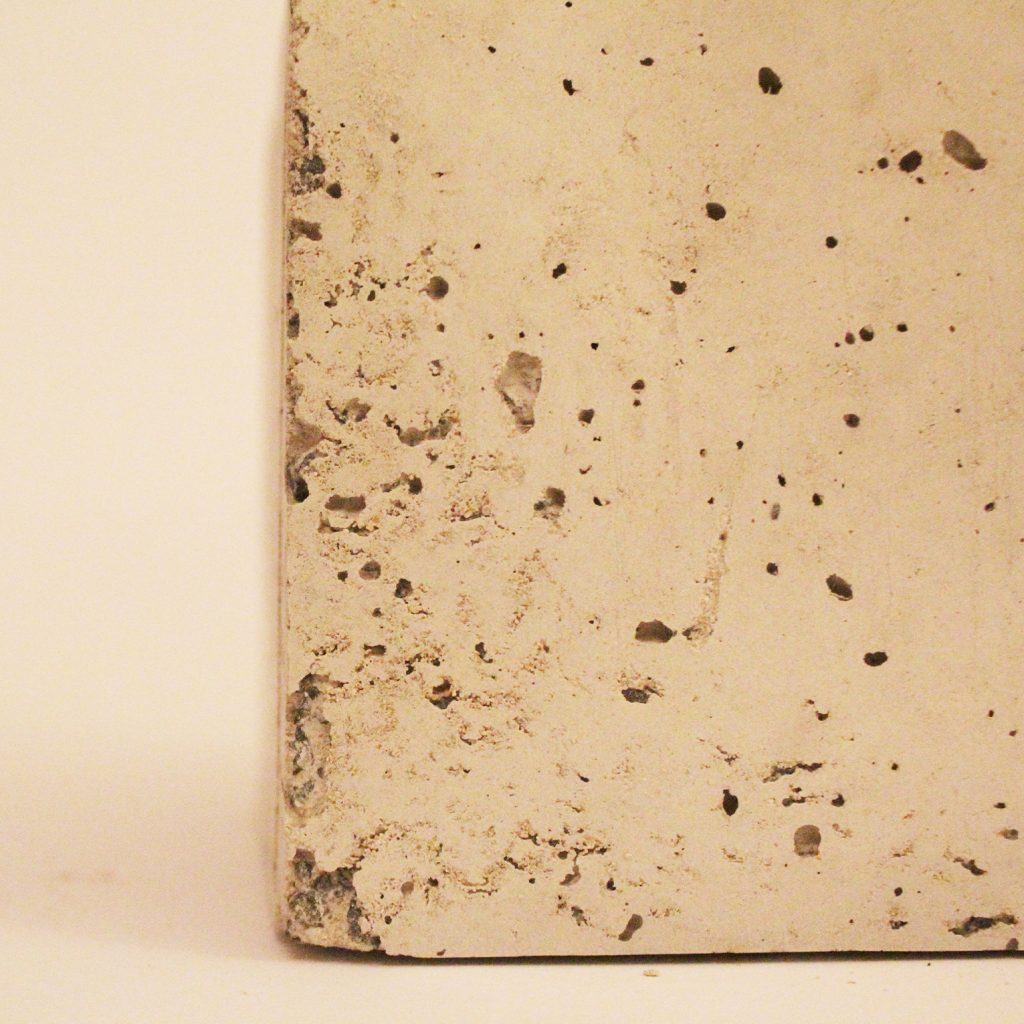
For ARDH, this approach is embodied in DuneCrete, a desert-sand-based low-carbon concrete developed in the UAE. DuneCrete allows concrete to remain part of the structural and environmental toolkit while reducing its footprint and linking it to local resources rather than distant riverbeds and quarries.
Perforated and shading elements:
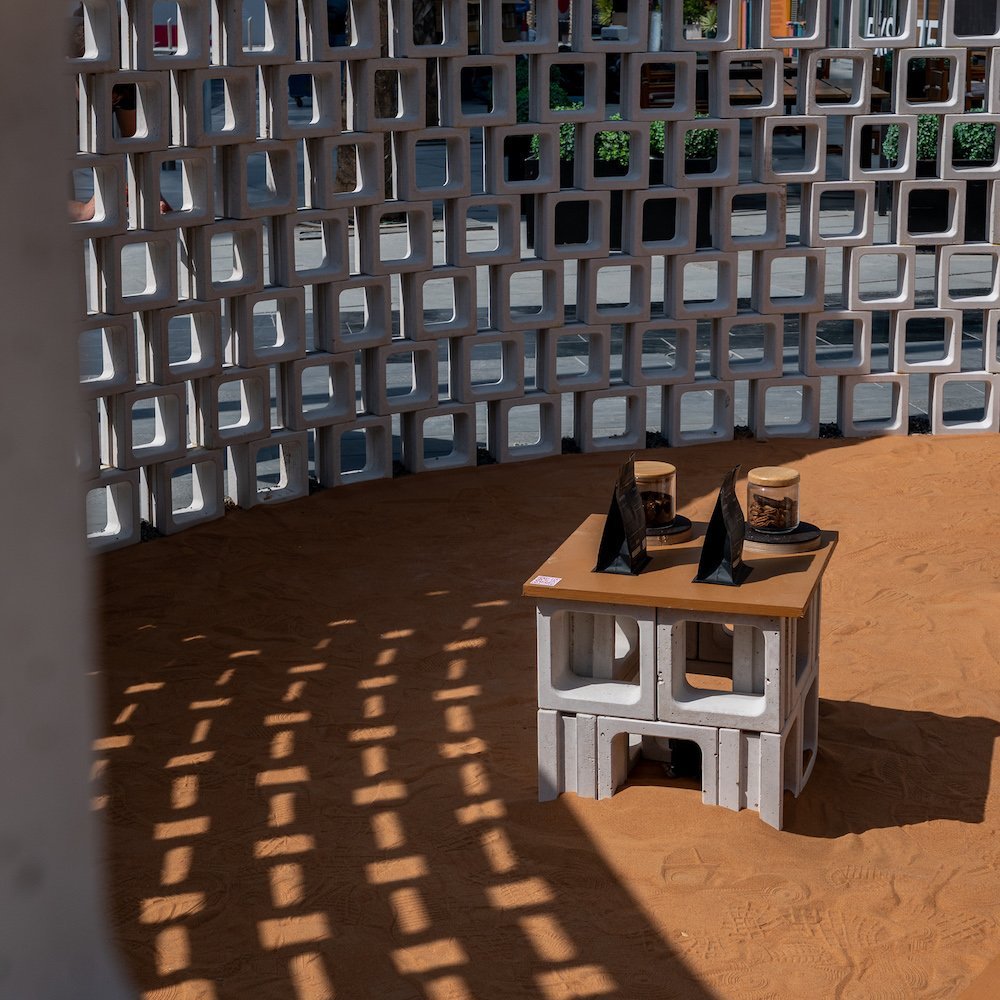
Shade and airflow are critical in hot climates. Perforated elements such as breeze blocks, screens and deep reveals help cut direct sun while maintaining light and ventilation.
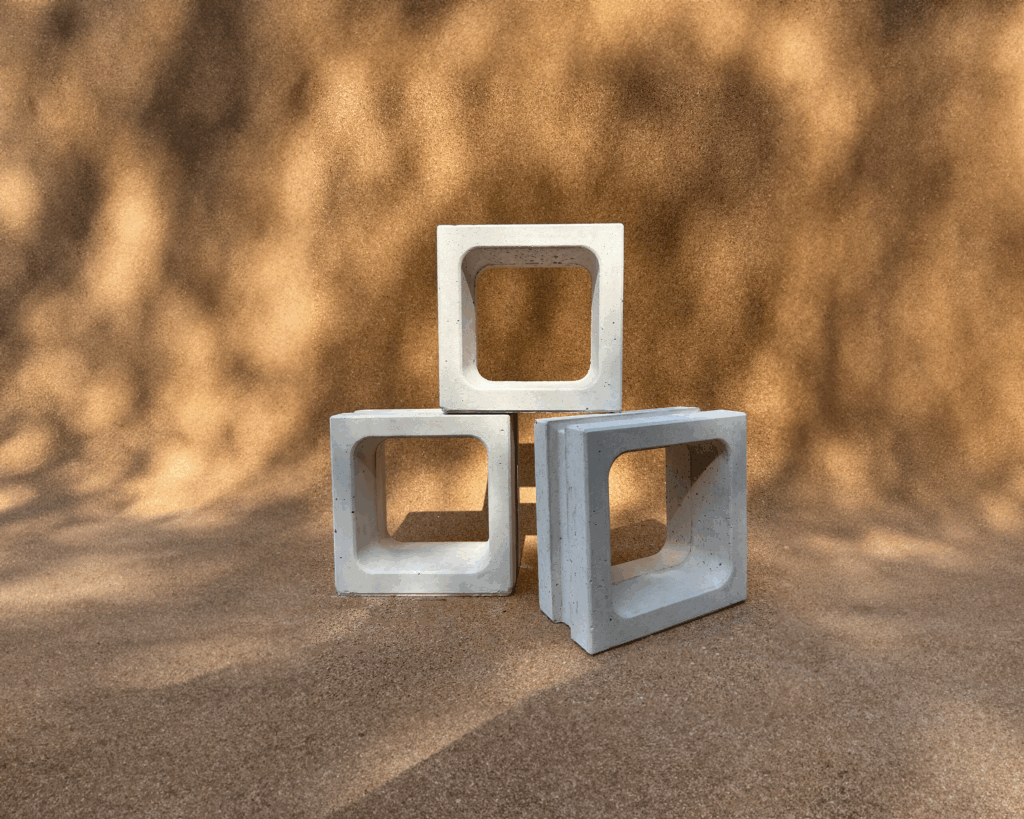
Eco-friendly versions of these systems combine effective shading with lower-impact concrete or masonry mixes. ARDH’s DuneBlocks take the familiar breeze block typology and remake it in DuneCrete low-carbon concrete, combining architectural pattern and shade with a more responsible material recipe.
Bio-based interior surfaces from regional resources:
For interiors, bio-based materials introduce warmth and tactility into otherwise mineral-heavy environments. In hot climates, they tend to perform best in protected interior applications where exposure is controlled but traffic can be high.
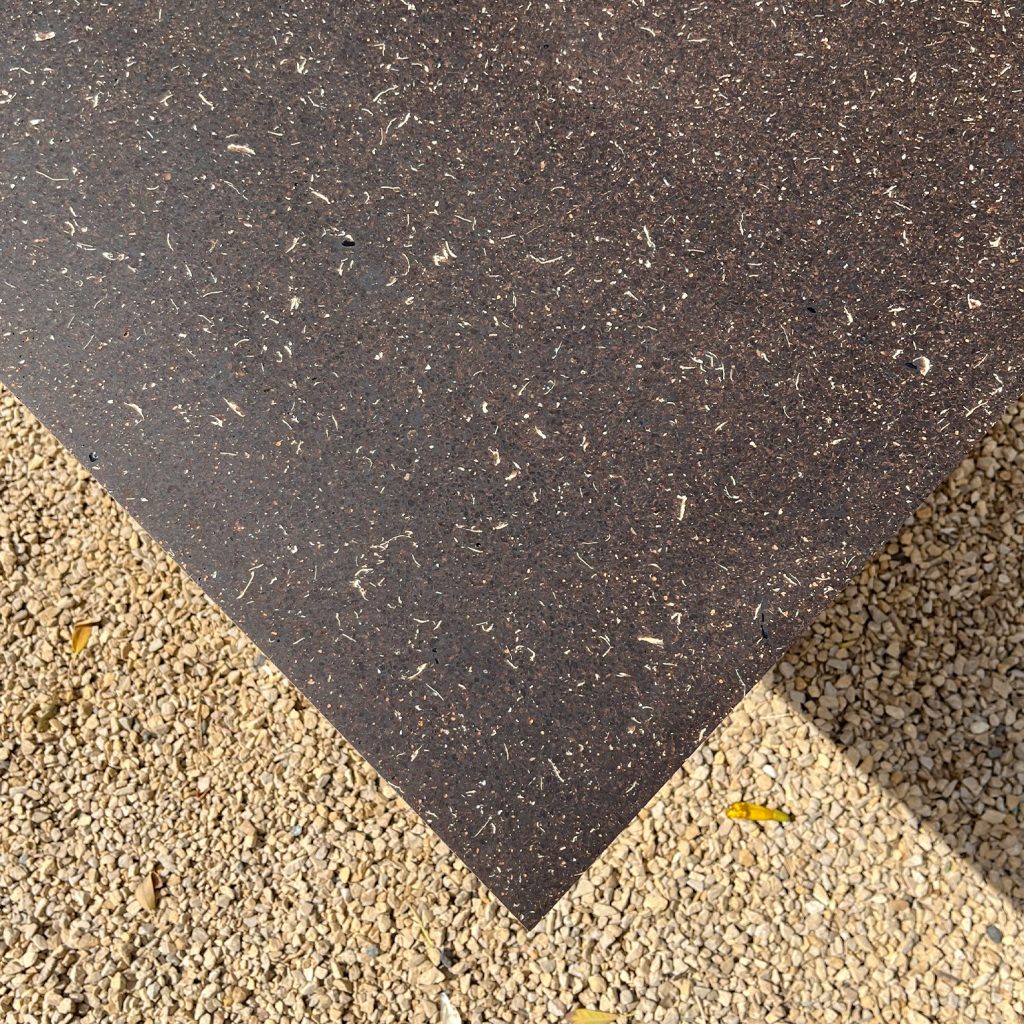
In the UAE, date agriculture provides a clear bio-based resource: the date seed. ARDH’s Dateform material turns date seeds into a five-millimetre solid surface layer bonded to birch plywood. Each panel contains thousands of seeds, making the material’s origin visible and tangible.
Dateform can be used for wall panels and feature walls, counters and reception desks, and furniture or shelving where the material story matters as much as the finish. It offers a bio-based, regionally rooted alternative to anonymous laminates and petrochemical solid surfaces.
Recycled and hybrid systems:
Eco-friendly building materials for hot climates also include recycled and hybrid systems. These might be recycled plastic composites for outdoor elements, panels that combine natural fibres with stable matrices, or the reuse of existing stone, masonry and metals in landscape and public-realm work.
The strongest solutions connect to local waste streams and local manufacturing capacity, instead of relying entirely on imported “green” products. ARDH’s materials sit alongside this wider ecosystem, focusing on a tight, coherent palette rather than a long, unfocused catalogue.
Design considerations specific to hot climates:
Once the right eco-friendly materials are in view, design decisions determine whether they actually perform.
Orientation and exposure remain fundamental. Shading elements such as breeze blocks and deep reveals should be placed where they intercept harsh sun but still admit useful daylight. More vulnerable materials, including some bio-based surfaces, should be protected from extreme direct exposure and weather.
Thermal and visual comfort need to be considered together. Low-carbon concrete, shading and planting can work in combination to soften microclimates. Bio-based surfaces and warm textures indoors help balance harder exterior materials such as concrete, stone and metal.
Maintenance and life cycle matter as much as first appearance. Finishes and assemblies should be cleanable and repairable without full replacement, and they need to perform under local cleaning practices, not only in controlled test environments.
Finally, supply and repeatability are essential. Eco-friendly materials must be available on time and at the required scale. The most effective partners are manufacturers who are willing to engage at concept and specification stage, not just at procurement.
How ARDH applies this thinking:
ARDH’s material family is intentionally focused.
DuneCrete is a low-carbon concrete using desert sand as a key component, designed for structural and public-realm applications. DuneBlocks are breeze blocks made from DuneCrete, providing shade, privacy and airflow with a clear material logic. Dateform is a bio-based solid surface made from date seeds for interior applications where touch and narrative matter.
Together, these materials form a small, coherent toolkit for eco-friendly building in hot climates. DuneCrete handles structure and external elements with reduced embodied carbon and local sourcing. DuneBlocks deliver shade and identity using the same low-carbon mix. Dateform brings bio-based warmth and regional storytelling into interior architecture.
Rather than offering a long list of unrelated “green” products, ARDH concentrates on sustainable building materials rooted in the desert and date agriculture of the UAE and GCC.
How ARDH can support your next project
For project teams exploring eco-friendly building materials in hot climates, ARDH can:
Provide clear overviews and technical information on DuneCrete, DuneBlocks and Dateform.
Join early design conversations to position these materials where they have the most environmental and spatial impact.
Coordinate with structural, sustainability and interior teams so the materials move smoothly from concept into drawings, specifications and construction.
To explore how ARDH’s sustainable building materials in the UAE can fit into an upcoming project, contact ARDH and share a brief outline of your scope, programme and timelines.